Korvus reads the financial newswires around the clock, scores every story for its
likely effect on index futures, and explains each one in plain language: what
happened, which instruments it touches, and which way it leans. One screen, and
you understand the session you are about to trade.
SESSION MAPAsia 6p-12aLondon 12a-8aNew York 8a-5pMarket closed · opens Sun 6:00 PM ET
NEWS & IMPACTSMT DIVERGENCEFUNDS WATCH
News & Market ImpactALLHIGHMEDLOW60 items
LOW
NEWSWIRE YAHOO FINANCE
Alvotech (ALVO) Receives FDA Form 483 Following Routine Facility Inspection
Alvotech received an FDA Form 483 following a routine facility inspection, flagging observations but not a warning letter.
▼ Bearishconf 35%
MED
NEWSWIRE YAHOO FINANCE
JPMorgan sets jaw-dropping Tesla stock price target
JPMorgan raises Tesla price target to a new high, signaling renewed bullish conviction amid broader EV and AI narratives.
▲ BullishTSLAMNQconf 62%
LOW
NEWSWIRE INVESTING.COM
Air New Zealand plans for elevated fuel costs into 2027
Air New Zealand guidance reflects persistently high jet fuel costs expected through 2027, pressuring airline margins.
▼ Bearishconf 35%
LOW
NEWSWIRE INVESTING.COM
Elon Musk to attend ASML tech conference to talk Terafab, Bloomberg
Musk confirmed to speak at ASML on Terafab, a Tesla/SpaceX manufacturing initiative, continued focus on advanced chip fabrication.
◆ NeutralTSLAconf 35%
SMT DivergenceNQ · ES · YM
✓ Confirming, aligned weakness
All three indices are near session lows together, confirming each other to the downside. No divergence.
NQvia QQQ
CLOSED
ESvia SPY
CLOSED
YMvia DIA
CLOSED
Funds WatchCLOSED32 symbols
NASDAQ HEAVYWEIGHTS
NVDANVIDIACLOSED
AAPLAppleCLOSED
MSFTMicrosoftCLOSED
AMZNAmazonCLOSED
METAMetaCLOSED
GOOGLAlphabetCLOSED
01
Scored news feed
Market-relevant headlines, collected and scored continuously, day and night.
02
Impact, direction, confidence
Each story carries a HIGH, MED, or LOW impact rating, a directional read, and a confidence score.
03
SMT divergence
NQ, ES, and YM measured against each other for confirmation or divergence at session extremes.
04
Macro, sessions, funds
A macro backdrop, the global session map, and a funds board of index heavyweights beside the feed.
What you get
A research desk for independent futures traders.
Most independent traders have charts and an execution platform, but no research desk. The context behind a move arrives late, scattered across feeds, group chats, and open tabs. Korvus consolidates that work: it gathers the news, evaluates it, and presents the result in a form you can read in seconds.
01 / COVERAGE
Continuous news coverage
The engine monitors financial newswires and market commentary 24 hours a day,
across a 59-instrument universe: index futures, the megacap equities that drive
them, currencies, rates, energy, metals, and agriculture. A story that breaks
overnight is already collected, summarized, and scored before you sit down.
Nothing depends on you watching the wires yourself.
02 / ANALYSIS
Every story scored and explained
Each item is summarized in plain language and rated on three axes: impact
(HIGH, MED, or LOW), direction (bullish, bearish, or neutral), and confidence.
The instruments a story touches are tagged on it, and routine noise is filtered
out so the feed stays readable. One pass tells you which of the day's headlines
deserve attention and why.
03 / STRUCTURE
Cross-index divergence, measured
Through US market hours, Korvus compares NQ, ES, and YM against their session
highs and lows and reports whether the three indexes are confirming each other
or diverging. Many index traders treat divergence at an extreme as an early
warning of a turn. Korvus measures the condition from market data instead of
leaving you to eyeball three charts.
04 / ONE SCREEN
Full session context in one place
The terminal places the scored feed beside a macro backdrop covering the dollar,
rates, gold, oil, credit, and volatility, the Asia, London, and New York session
map, a funds board of index heavyweights, and live market television from third
party broadcasters. Everything you would normally check before and during a
session, on a single screen.
How it works
How the engine works.
Every stage is automated and runs around the clock. This is the path a headline takes from publication to your screen.
01
Collect
Financial newswires and market commentary stream into the engine continuously, day and night.
02
Analyze
Each item is summarized, then scored for impact, direction, and confidence, and mapped to the instruments it affects.
03
Deliver
Scored items land on your terminal shortly after publication, filterable by impact level.
04
Decide
You read the context and make your own call. Korvus provides information, never trade signals.
Before you decide
What Korvus is, and what it is not.
Trading tools tend to oversell. Before you create an account, here is a plain statement of what you are buying and where the limits sit.
What it is
An information terminal, described plainly.
Korvus collects financial news, evaluates each story with an automated analysis engine, and presents the result next to live market context. Its job is to shorten the time between something happening in the market and you understanding what it means for the indexes.
It does not place trades, generate entry signals, or predict outcomes, and it will not promise you profitability. Trading index futures carries substantial risk, and every decision remains yours. Treat the scoring as a well organized starting point for your own judgment, because that is what it is.
We built it this way on purpose. A tool that is honest about its limits is a tool you can actually rely on.
No surprises
What you are signing up for
A free account, no credit card. Setup takes about a minute.
The full 24/7 scored news feed, included on the free Observer tier.
The global session clock and Session Map, included on the free tier.
Your watchlist and settings, saved to your account and synced across devices.
Email only when it matters. No marketing blasts; unsubscribe in one click.
Your data stays yours. Leave or delete your account anytime.
Pro is optional, $9.99/mo, cancel anytime, no lock-in.
Automated analysis, not advice. A machine reads and scores the news; it informs your decision and never makes it.
LodeStone · included with Pro
The terminal reads the news. LodeStone reads your chart.
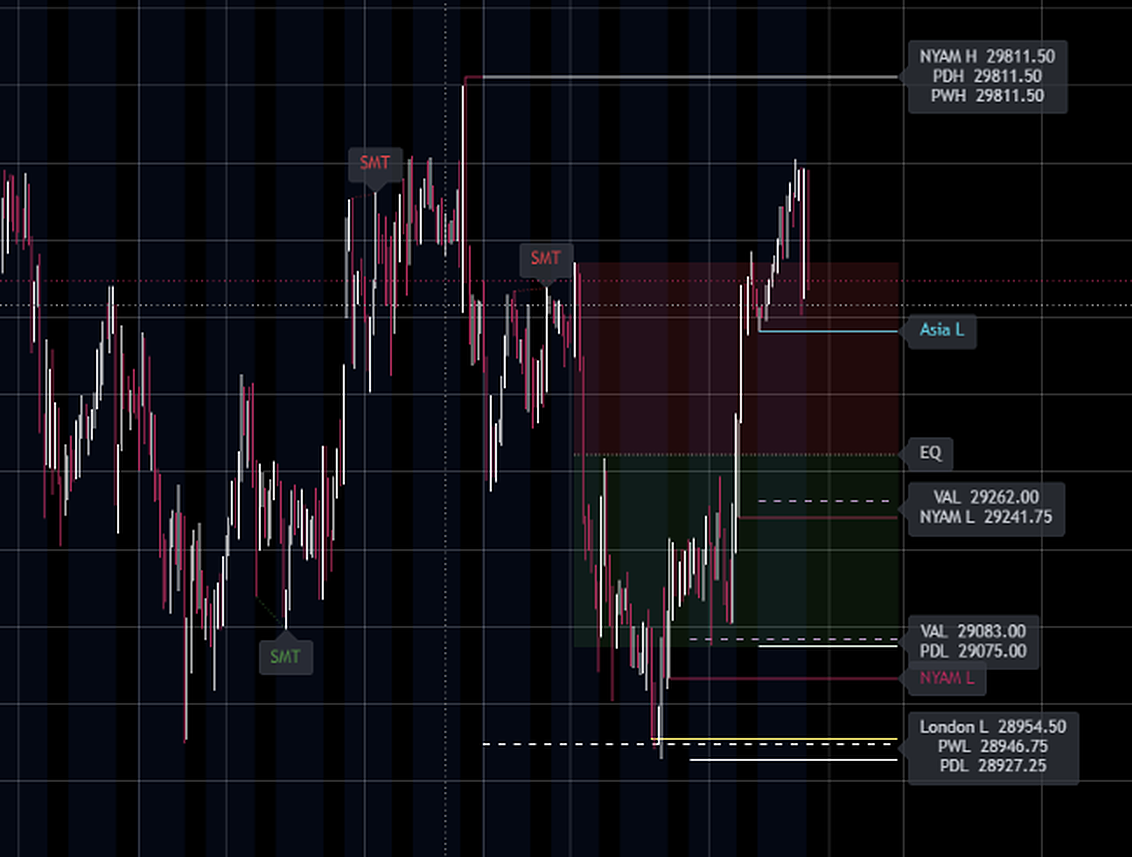
LodeStone is our TradingView indicator for intraday index futures:
an ICT liquidity context tool that marks the levels that matter and keeps the chart clean while it does it.
It is included with the Operator (Pro) membership at no extra cost.
Session levels. Completed Asia, London, NY AM and NY PM highs and lows, plus prior day and prior week.
Premium / Discount. A dealing range with equilibrium, so you know which half of the range you are paying in.
Resting liquidity. Relative equal highs and lows, reinforced instead of duplicated.
SMT divergence. Your chart's swings against a correlated symbol, with automatic NQ and ES pairing.
Restrained volume profile. Naked POCs and value area levels. No histogram, ever.
Everything prints on confirmed bars only, so nothing repaints. And it will never draw an arrow
or tell you to buy or sell. Context and decision support, deliberately.
LodeStone on NQ (CME), 1-hour chart on TradingView. Real market data, real capture.
Pricing
Start free. Upgrade for real-time data.
Both tiers run on the same 24/7 news analysis engine. Pro adds real-time quotes and live SMT divergence during US market hours, personal watchlist imports, email alerts on high-impact items, and the LodeStone TradingView indicator.
Live price panels stream during US market hours (9:30 AM to 4:00 PM ET). Outside those hours they show a clear CLOSED state while the 24/7 scored news feed and high-impact alerts keep running.
Secure checkout by Stripe. Subscription auto-renews monthly until cancelled; cancel anytime from your account. Terms ·
Privacy ·
Risk Disclosure
Important: Korvus is an informational and educational tool, not financial, investment, legal, or tax advice, and not a recommendation to buy or sell any security, futures contract, or other instrument. Trading futures and leveraged products involves substantial risk of loss and is not suitable for everyone. You alone are responsible for your own trading decisions and outcomes. Market data shown on Korvus is provided for informational context through licensed third-party providers and may be delayed; Korvus does not redistribute real-time exchange market data. The live price panels stream during regular US trading hours (9:30 AM to 4:00 PM ET); outside those hours they display a clear closed state rather than live prices. See our Risk Disclosure for full terms.